
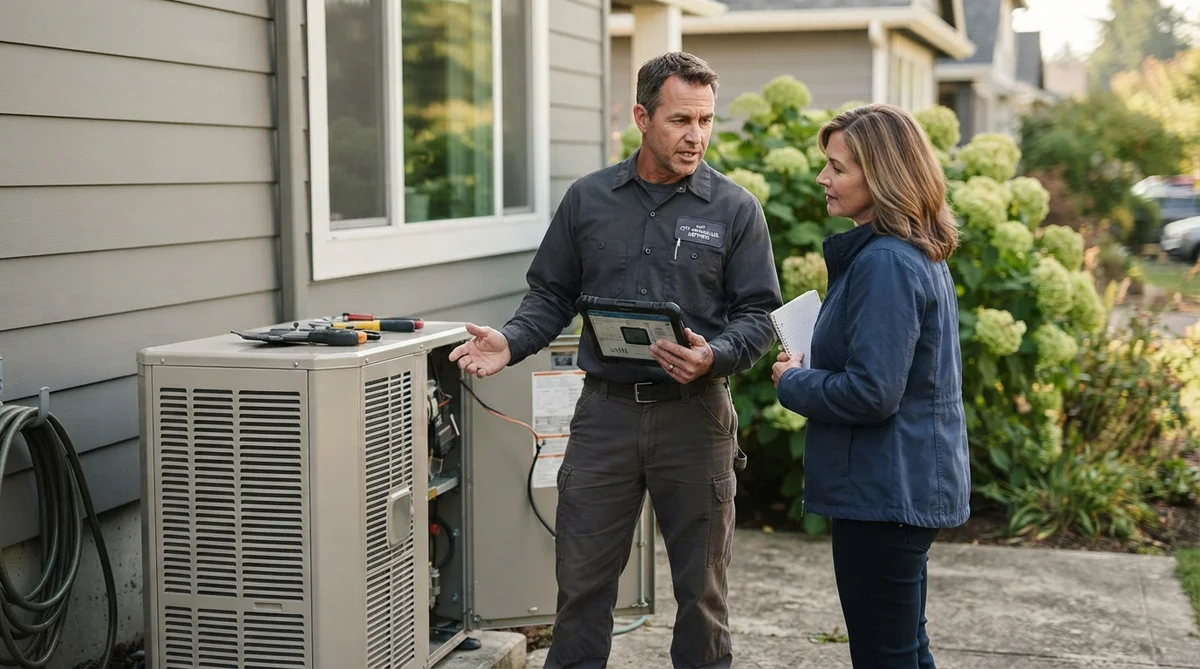
To run effective AI roleplay training for HVAC technicians, give the technician a specific non-technical task: explain an inspection finding in clear everyday language, verify what the customer understands, and confirm next steps without rushing into sales or technical jargon. For example, a technician explains worn blower motor bearings by describing mechanical friction rather than part codes, pauses to invite questions, and agrees on an estimate review timeline.
Key Takeaways
- Service conversations fail when technicians rely on equipment codes instead of plain-language explanations of function and impact.
- Effective AI roleplay exercises isolate conversation milestones: the observation, the functional explanation, the understanding check, and the agreed next step.
- Rubrics must measure observable conversational actions - such as explicit pauses and open-ended checks - rather than vague impressions of politeness.
- Iterative simulation lets technicians correct defensiveness or over-explaining immediately in a low-stakes environment.
Why Focus on Service Explanations?
Field technicians are often trained thoroughly on diagnostic tools and safety procedures, but customer communication is frequently left to chance. When a technician finishes an inspection and approaches a homeowner, the conversation determines whether the customer feels informed or cornered.
Broad communication training rarely works because it lacks context. By using targeted roleplay, technicians repeatedly rehearse how to translate a diagnostic finding into practical terms. This guide focuses entirely on the conversation: explaining what was found, checking comprehension, and agreeing on what happens next. It contains no diagnostic advice, repair steps, or safety procedures.
The Practice Exercise: Fictional HVAC Service Roleplay
This exercise simulates a routine maintenance visit where the technician discovers an issue that does not require immediate shutdown but will cause performance degradation if ignored.
Fictional Scenario Setup
Role: HVAC Service Technician speaking with a cautious homeowner (Fictional Character: Morgan Reed).
Driving question or Task: Explain that the outdoor condenser fan motor is drawing higher electrical current than normal and shows early signs of bearing wear, verify that Morgan understands what that means for summer cooling, and agree on an estimate review step without applying high-pressure sales tactics.
Ambiguity: The cooling system is currently running. Morgan is skeptical of maintenance visits, has limited technical knowledge, and suspects the company is inventing problems to sell unnecessary replacements.
What good looks like: The technician speaks at an even pace, uses an analogy such as friction in a bicycle wheel, actively pauses to ask an open question ("How familiar are you with how the fan moves heat away from your house?"), acknowledges Morgan's budget concerns neutrally, and concludes with a clear choice: "I will document the exact readings in your visit summary and send over a clear estimate, and you can decide how you want to proceed."
Roleplay Prompts and Participant Cards
When running this in an AI simulation platform or peer coaching session, provide the following parameters:
- AI Customer Persona (Morgan Reed): Homeowner working from home. Direct, budget-conscious, slightly guarded. If the technician uses unexplained terms like amperage draw or capacitor microfarads, Morgan responds with: "Is it working right now? Because it feels fine in here. I don't want to buy parts I don't need." If the technician explains the friction clearly and checks in, Morgan relaxes and asks about timeline options.
- Technician Objective:
- State the finding using functional language (what the component does).
- Connect the finding to customer impact (reliability during high temperatures, not fear tactics).
- Ask an open-ended question to confirm understanding.
- Propose a clear, low-pressure next step (e.g., providing an itemised estimate for review).
Observable Behaviour Rubric
When scoring technician performance during an AI roleplay or post-session review, evaluate observable behaviours rather than subjective tone. A reviewer or automated scoring model should assess four distinct criteria:
| Competency | Target Behaviour (Score 3) | Developing Behaviour (Score 2) | Unacceptable Behaviour (Score 1) |
|---|---|---|---|
| Plain-Language Explanation | Explains mechanical issue using functional analogies; avoids raw part numbers or uncontextualised electrical readings. | Uses technical terms but attempts a brief definition when prompted by customer confusion. | Recites diagnostic codes and measurements without translation; confuses customer. |
| Comprehension Verification | Uses an open question to verify understanding (e.g., "What questions do you have about how this affects the unit?"). | Uses a closed confirmation (e.g., "Does that make sense?") without giving room for questions. | Moves directly from finding to price or schedule without pausing to check comprehension. |
| Customer Perspective Handling | Validates skepticism calmly; acknowledges that the system is currently producing cold air. | Acknowledges customer hesitation but quickly repeats the finding. | Becomes defensive, dismissive, or uses alarmist language to force agreement. |
| Action Agreement | Outlines clear, low-pressure options with specific timing for follow-up documentation. | States the next step but leaves timing or delivery vague. | Demands an on-the-spot purchasing decision or leaves the customer unsure of what happens next. |
Common Technician Mistakes
- The "Does That Make Sense?" Trap: Asking closed questions encourages polite nodding. Replace it with: "What can I clarify about how this part operates?"
- Catastrophising: Telling a customer their system is "a ticking time bomb" damages trust when the system is still cooling the house. Frame findings around predictability and preventing unplanned breakdowns during peak heat.
- Over-Explaining Diagnostic Mechanics: Spending five minutes explaining electrical resistance overwhelms the customer. Focus on function, wear, and eventual failure outcome.
- Failing to Close the Loop: Leaving the homeowner with "just let us know what you want to do" creates friction. Always state who has the next action and when.
Next Practice Attempt: Iterating the Roleplay
Once a technician achieves a passing score on the baseline scenario, introduce realistic variations in the AI prompt or peer roleplay setup to build adaptive communication skills:
- Variation A (Time-Pressed Customer): The customer has three minutes before a conference call. The technician must deliver the finding, check understanding, and establish the delivery method for the written quote in under 90 seconds.
- Variation B (Secondary Decision-Maker): The customer says, "I have to explain this to my spouse tonight." The technician must equip the customer with a simple, jargon-free summary and offer to attach an explanatory note to the email estimate.
Implementing HVAC Roleplay with Scenario IQ
Practising these conversations consistently across a distributed team of field technicians requires structured rehearsal. Dedicated AI roleplay training software eliminates the scheduling bottlenecks and inconsistency of peer-to-peer roleplaying.
Scenario IQ provides AI-powered roleplay simulations designed to develop critical communication and service skills. The platform develops bespoke scenarios tailored to an organisation's specific industry, customer objections, and service processes. HVAC service organisations can configure custom customer personas - from skeptical homeowners to busy property managers - allowing technicians to practise delivering service findings in a realistic, conversational format.
Within Scenario IQ, learners can choose their roleplay scenario, adjust skill levels, and follow structured training paths. After completing a conversation, technicians receive instant feedback with personalised guidance highlighting strengths and areas for improvement. This evaluation draws on thousands of research-informed data points to evaluate interaction quality, assessing tone, pacing, keyword usage, and overall communication style.
Through dedicated management dashboards, service managers and trainers can monitor staff progress over time, review reflections on recent interactions, and access performance insights to guide ongoing field coaching. To learn how bespoke AI roleplay scenarios can refine customer communication across your technician team, contact Scenario IQ to explore a consultation and platform setup.
FAQ
How can trainers teach AI roleplay training for HVAC with a practical scenario?
Trainers should define a specific conversational boundary: give the technician a concrete diagnostic finding, assign the customer a distinct personality (such as budget-conscious or skeptical), and restrict the task to explanation, comprehension checking, and agreeing on next steps. Evaluating the interaction against specific observable behaviours ensures the focus remains on customer communication rather than technical diagnosis.
What should a useful AI roleplay training for HVAC exercise include?
A useful exercise includes a defined customer persona with realistic conversational triggers, a clear non-urgent service finding, an ambiguity factor (such as equipment that is still functioning), an explicit rubric measuring communication habits, and guidance for a follow-up iteration with added complexity.
What observable behaviours should a reviewer score for AI roleplay training for HVAC?
Reviewers should score whether the technician avoids unnecessary jargon, whether they check comprehension using open-ended phrasing rather than closed questions, how calmly they respond to customer pushback, and whether they confirm a clear, low-pressure next step for both parties.
HVAC Service Finding Communication Practice Sheet
Copy this worksheet and adapt it to your learners. Any example entries are illustrative. On small screens, scroll across the worksheet.
| Stage | Technician Objective | Fictional Example / Scripting Model | Comprehension Check Prompt | Common Error to Avoid |
|---|---|---|---|---|
| 1. The Finding | State the observation in functional, everyday terms. | "During the inspection, I checked the outdoor fan assembly. The motor bearings are starting to show friction wear, which makes the motor work harder than designed." | "Before we talk about what to do, how familiar are you with what this outdoor fan does?" | Reading out motor amperage or capacitor microfarad ratings directly. |
| 2. The Impact | Explain the consequence of inaction without catastrophising. | "Right now it is keeping the house cool, but increased friction means it runs hotter and could give out unexpectedly during high summer temperatures." | "What questions do you have about how that motor affects the cooling in the house?" | Claiming the unit is dangerous or an immediate emergency when it is not. |
| 3. Next Steps | Agree on clear, documented action with no high-pressure tactics. | "I'll document our readings and email you an itemised quote this afternoon so you can review the options with your family." | "Does that timeline work for you to look it over, or would you prefer a follow-up call tomorrow?" | Pushing for an immediate signed contract before the customer understands the scope. |
| Technician Practice Row | [Your target finding] | [Your functional description] | [Your open check] | [Pitfall to avoid] |