
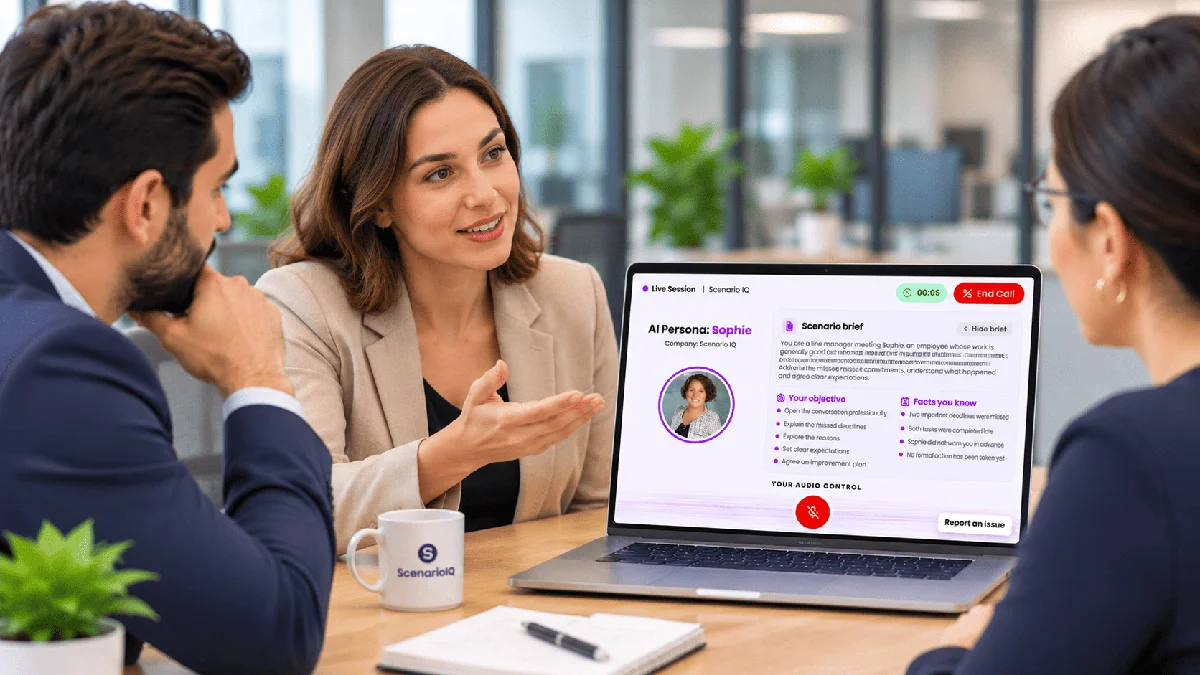
Effective AI roleplay training for sales teams starts with one realistic conversation and one measurable skill. Rather than asking a representative to “be more persuasive,” give them a specific buyer, a credible objection, and a clear task: discover the buyer’s priorities, respond without becoming defensive, explain relevant value, and agree on an appropriate next step. For example, a sales representative practises speaking with an operations manager who likes the proposed software but worries about implementation effort and an already stretched budget.
Key Takeaways
- AI sales roleplay is most useful when scenarios reflect real buyer personas, objections, products, and sales stages rather than generic scripts.
- Train observable behaviours: purposeful discovery questions, active listening, accurate value explanations, calm objection handling, and next-step agreement.
- Use consistent scoring rubrics and repeat attempts so representatives know what changed, not simply whether an AI evaluator gave them a higher score.
- Combine independent AI practice with manager coaching and real-call outcomes; simulated performance alone does not prove increased revenue.
- Start with a focused pilot, protect customer information, and expand only when training improves the skills your team actually needs.
Why Sales Teams Need More Than Scripts and Workshops
Sales enablement programmes often provide messaging decks, product information, objection-handling sheets, and recorded examples. These resources explain what good selling looks like, but they do not guarantee that a representative can use the right words when a buyer challenges pricing, interrupts a discovery call, or questions the return on investment.
Traditional peer roleplay can help, yet it is difficult to schedule consistently and may feel artificial when colleagues already know the expected answers. AI-powered practice creates another option: representatives can rehearse a conversation with a simulated buyer, encounter different responses, review feedback, and try again before the next customer meeting.
The goal is not to memorise a perfect script. It is to build a reliable conversation structure that remains useful when the buyer changes direction. A strong training programme treats AI simulation as a practice environment, while managers remain responsible for coaching judgment, product accuracy, and appropriate commercial commitments.
Five Sales Skills to Build Through AI Roleplay
1. Open the Conversation and Establish Relevance
Representatives should be able to introduce the purpose of a call without delivering a lengthy product pitch. Practise opening with a brief agenda, confirming the buyer’s priorities, and asking permission to explore the problem. A useful opener might be: “You mentioned that reporting takes your team several hours each week. Would it be useful to start with where that time is going?”
Score whether the representative sets a relevant agenda and invites participation, not whether they use an exact approved sentence.
2. Ask Discovery Questions That Reveal the Real Problem
Discovery is more than collecting a list of answers. Train representatives to ask open questions, listen to the response, and follow up on the consequences of the problem. For example: “What happens when those reports are late?” may uncover operational delays that a generic question about software features would miss.
AI buyer personas can be configured to reveal important context only when the learner asks an appropriate question. This encourages genuine exploration instead of rewarding a fast pitch.
3. Handle Objections Without Arguing
Price, timing, trust, integration, and competitor objections are normal parts of selling. A useful response acknowledges the concern, clarifies what is behind it, and responds with relevant information. When a buyer says, “Your solution is too expensive,” the representative should first find out whether the concern is affordability, uncertain value, or comparison with another proposal.
Practise separating questions from assumptions. Avoid training representatives to dismiss objections or promise discounts, capabilities, and results they are not authorised to offer.
4. Connect Value to the Buyer's Own Priorities
Feature lists rarely address the buyer’s underlying decision. Train representatives to explain a capability in the context of the problem the buyer has described. Instead of saying, “We have automated dashboards,” a stronger response is: “If your managers are spending time compiling updates manually, this reporting workflow may reduce that administrative work. We can test whether it fits your process.”
The scoring focus should be on relevance and accuracy, not exaggerated promises of return on investment.
5. Confirm a Specific, Mutual Next Step
A good sales conversation does not always end in a sale. It should end with clarity. Representatives need to summarise what they heard, confirm outstanding questions, identify the next decision-maker, and propose an appropriate action with ownership and timing. “I will send an implementation outline by Thursday, and we can review it with your IT lead next Tuesday” is more useful than “I'll follow up soon.”
The Practice Exercise: Fictional B2B Sales Objection Roleplay
This fictional exercise is designed for a sales representative selling workflow software to a mid-sized company. The prospect has genuine interest but is cautious about budget, staff time, and whether the product will work with existing systems. The scenario tests discovery and objection handling rather than aggressive closing.
Fictional Scenario Setup
Role: Account Executive speaking with Jordan Ellis, Operations Manager at the fictional company Northbridge Services.
Driving question or Task: Understand Jordan’s reporting bottleneck, explore concerns about implementation and budget, explain relevant product value without inventing functionality, and agree on a sensible evaluation step.
Ambiguity: Jordan says the current process is frustrating but still works. Another vendor has quoted a lower price. Jordan is not the final budget owner, and the internal IT team is already busy. The representative has no authority to promise a discount or guarantee an integration.
What good looks like: The representative asks how the current process affects staff, acknowledges the comparison with the cheaper vendor, explores what Jordan would need to feel confident about implementation, and offers a follow-up involving the appropriate technical and budget stakeholders. The representative avoids pressure and distinguishes verified product capabilities from questions requiring confirmation.
Roleplay Prompts and Participant Cards
Use the following instructions in an AI simulation platform or a facilitator-led practice session. Replace the fictional product details with approved information from your organisation before training real employees.
- AI Buyer Persona (Jordan Ellis): Practical, time-conscious operations manager. Jordan initially says: “We know our reporting process could be better, but your quote is higher than the alternative and I cannot take on a complicated rollout.” If the representative launches into a feature pitch, Jordan becomes more sceptical. If the representative asks about current reporting effort and implementation constraints, Jordan explains that managers manually combine reports every Friday and that IT can only support a limited pilot this quarter. Jordan will not agree to purchase on the first call.
- Representative Objective:
- Confirm Jordan's main operational problem and its consequences.
- Explore whether the price concern reflects budget limits, uncertain value, or competitor comparisons.
- Address implementation worries using approved information and transparent limitations.
- Summarise priorities and propose a realistic evaluation meeting or pilot discussion.
- Scenario Guardrails: Do not fabricate product integrations, customer testimonials, savings figures, discounts, or contractual terms. The learner should identify what needs verification and arrange the appropriate follow-up.
Observable Behaviour Rubric for Sales Roleplay
Assess what the representative actually says and does. Use the same rubric across repeated attempts so feedback remains consistent. The following three-point scale is illustrative and can be adapted to your sales methodology.
| Competency | Target Behaviour (Score 3) | Developing Behaviour (Score 2) | Unacceptable Behaviour (Score 1) |
|---|---|---|---|
| Discovery and Listening | Asks open questions, follows up on business impact, and accurately summarises Jordan's priorities. | Asks relevant questions but misses an important consequence or moves on too quickly. | Assumes the problem, interrupts repeatedly, or launches into a pitch without discovery. |
| Objection Handling | Acknowledges budget and rollout concerns, clarifies their causes, and responds without arguing. | Recognises objections but provides a generic reassurance or incomplete answer. | Dismisses concerns, criticises the competitor, or pressures the buyer to decide. |
| Value and Accuracy | Connects verified capabilities to reporting problems and clearly flags unknown details for follow-up. | Explains capabilities accurately but relies on broad benefits rather than buyer-specific relevance. | Invents savings, integrations, or commercial commitments, or relies on an unrelated feature list. |
| Next-Step Agreement | Summarises open questions and agrees on a specific next action, owner, and timeframe. | Suggests a useful follow-up but leaves timing, attendees, or ownership unclear. | Ends without a plan or demands an immediate purchase decision. |
A score is a coaching aid, not a substitute for reviewing the conversation. If a representative receives a low score for objection handling, identify the exact moment they interrupted or made an unsupported promise. Then ask them to replay that part of the scenario using one improved behaviour.
Common Mistakes in AI Sales Roleplay Training
- Training Generic Persuasion: A prompt such as “sell the product successfully” encourages vague performance. Define a buyer, a problem, a constraint, and observable success criteria instead.
- Rewarding Talk Time: Speaking confidently is not the same as understanding the customer. Assess the quality of questions and summaries, not how long the representative talks.
- Using Unrealistically Agreeable Buyers: A buyer who accepts every explanation does not prepare the team for real objections. Include credible hesitation and incomplete information.
- Making Scores the Only Goal: Learners may optimise for the rubric rather than the customer. Review representative transcripts and real-call outcomes alongside simulated scores.
- Practising Without Product Guardrails: Unverified claims about pricing, integrations, security, or expected savings create risk. Use approved content and clear escalation rules.
- Running One Session and Stopping: Improvement requires repetition. Use a short practice, review one specific mistake, and repeat the conversation with a slightly different buyer response.
Next Practice Attempt: Increase the Difficulty
Once a representative can complete the baseline scenario consistently, change one condition at a time. This tests adaptability without making it impossible to identify which skill needs work.
- Variation A (The Price-Focused Buyer): Jordan says, “The other vendor is twenty percent cheaper. Why should I even consider you?” The representative must explore comparison criteria and explain relevant value without criticising the competitor or promising an unauthorised discount.
- Variation B (The Unexpected Stakeholder): Jordan says, “Our IT director will join the next call, and she is worried about data migration.” The representative must acknowledge the concern, avoid technical guesses, and arrange for a qualified colleague to answer integration questions.
- Variation C (The Rushed Prospect): Jordan has only two minutes left. The representative must summarise the problem, identify the most important unresolved issue, and agree on a concise follow-up without forcing a rushed close.
A Practical 30-Day AI Sales Roleplay Training Plan
A focused pilot is easier to evaluate than rolling out dozens of scenarios to every team at once. Choose one role, one sales stage, and two or three competencies before the first session.
| Period | Training Activity | Manager Check | Evidence to Collect |
|---|---|---|---|
| Week 1: Baseline | Run one discovery and objection-handling scenario without coaching beforehand. | Review a sample of conversations and agree on scoring definitions. | Initial rubric scores, common errors, and learner confidence. |
| Week 2: Targeted Practice | Repeat short roleplays focused on the lowest-scoring skill. | Give one actionable coaching point per learner. | Changes in questioning, listening, and objection handling. |
| Week 3: Variations | Introduce tougher buyers, budget concerns, or additional stakeholders. | Check whether skills transfer to a different scenario. | Consistency across attempts and new scenarios. |
| Week 4: Review | Repeat the baseline and compare against relevant real-call examples. | Decide what to reinforce, revise, or expand. | Rubric improvement, manager observations, and available sales indicators. |
Track leading indicators such as practice participation, skill scores, and manager-rated call quality. Where data is available, also examine meeting-to-next-step conversion, opportunity progression, or time to proficiency. Changes in pipeline outcomes may reflect many factors, so avoid claiming that roleplay alone caused an improvement without a suitable comparison.
Implementing Sales Roleplay Training With Scenario IQ
Scaling realistic practice across new hires, experienced representatives, and distributed teams requires more than occasional manager-led sessions. Dedicated AI roleplay training software can provide repeatable conversation simulations and a more consistent way to review progress.
Scenario IQ is designed around AI-powered, scenario-based training for sales and customer-facing teams. Organisations can create tailored roleplays that reflect their products, customer personas, objections, and training objectives. A team might build separate scenarios for early-stage discovery, pricing pushback, renewal discussions, or a buyer who needs approval from multiple stakeholders.
Representatives can practise conversations with AI personas, work through different skill levels, and receive feedback after an attempt. Scenario IQ supports customised evaluation criteria, including communication and sales competencies, so managers can focus feedback on behaviours that matter to their organisation rather than relying on a single generic score.
Management reporting and progress analytics can help trainers identify recurring gaps, compare performance over repeated attempts, and decide where human coaching is needed. For a practical starting point, create one roleplay based on a common objection from recent sales calls, define four observable success criteria, and review the first round of results with a frontline manager.
Explore Scenario IQ to discuss a sales training scenario and assess whether the platform fits your team's enablement goals, data requirements, and coaching process.
FAQ
What is AI roleplay training for sales teams?
AI roleplay training lets sales representatives practise conversations with simulated buyers who respond to their questions, explanations, and objections. A useful programme combines realistic buyer personas, clear objectives, structured feedback, and repeat attempts. It complements product training and manager coaching rather than replacing real customer experience.
Which sales conversations should teams practise first?
Start with frequent, high-impact situations where the team currently struggles: discovery calls, pricing objections, competitor comparisons, delayed decisions, or agreement on next steps. Choose one scenario with a clear buyer problem and define the behaviours that would make the conversation successful. Expand to more complex scenarios after learners demonstrate consistent progress.
How can managers measure whether AI sales roleplay is effective?
Use baseline and repeat roleplay scores, review specific conversational behaviours, and compare findings with manager assessments of real calls. Where possible, monitor relevant operational indicators such as discovery quality, next-step rates, and ramp time. Evaluate whether skills transfer beyond the simulation, and account for other factors that can affect sales results.
Sales Roleplay Conversation Practice Sheet
Copy this worksheet for your next team practice session. All example details are fictional and should be adapted to your approved product messaging and sales process. On smaller screens, scroll horizontally to view the complete table.
| Conversation Stage | Representative Objective | Fictional Example / Scripting Model | Coaching Check | Common Error to Avoid |
|---|---|---|---|---|
| 1. Discover | Understand the current problem and its impact. | "You mentioned the weekly reporting process takes time. Which part causes the biggest delay for your team?" | Did the representative ask a follow-up and summarise the answer? | Starting with a product demonstration before understanding the need. |
| 2. Clarify Objection | Identify what is behind the price or implementation concern. | "When you compare the two proposals, is the biggest concern the upfront budget, the rollout effort, or the value you expect?" | Did the representative acknowledge and clarify the concern? | Arguing that the competitor is inferior or offering an unapproved discount. |
| 3. Explain Value | Connect a verified capability to the buyer's stated priority. | "Based on what you described, the reporting workflow may be relevant. We can confirm how it would fit your current process in a pilot discussion." | Was the explanation accurate and specific to the buyer? | Promising guaranteed savings or unsupported integrations. |
| 4. Agree Next Step | Confirm who will do what and by when. | "I'll send the implementation questions today. Would a 20-minute review with your IT lead next week be useful?" | Was the next action mutually agreed with an owner and timeframe? | Ending with "I'll be in touch" or pressuring for an immediate purchase. |
| Team Practice Row | [Your target competency] | [Your approved conversation example] | [Your observable scoring question] | [Pitfall to avoid] |