
Last updated: September 2026
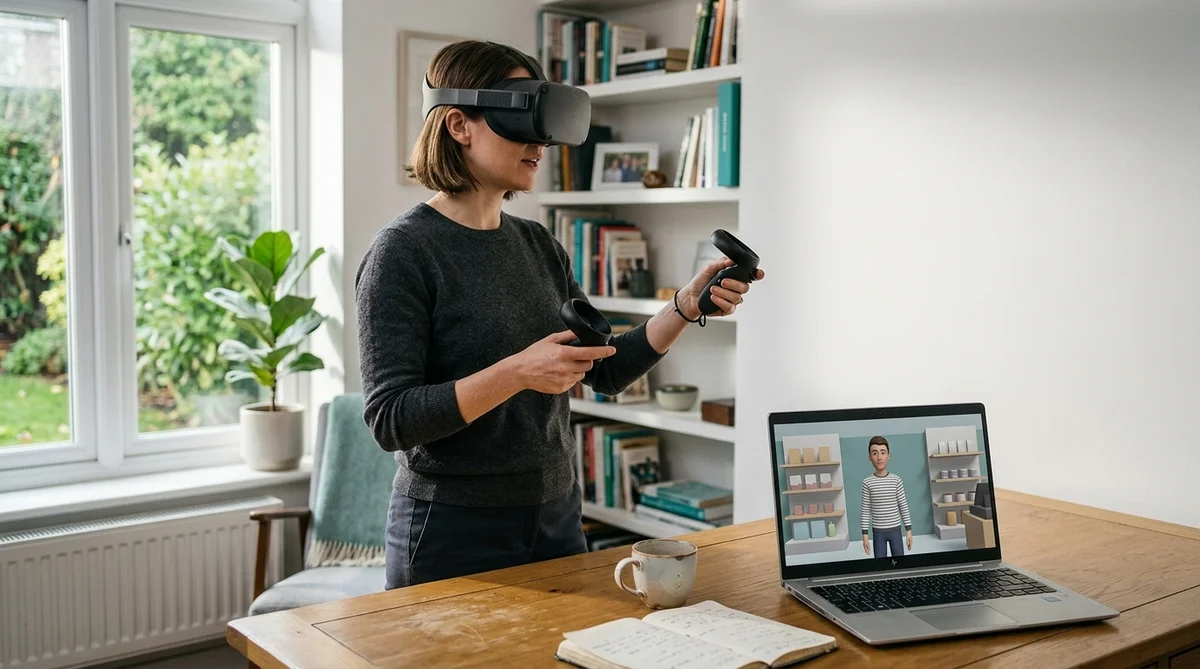
Immersive training is a learning method that uses Virtual Reality, Augmented Reality, or AI simulations to replicate real-world environments for skill development. It's designed to provide hands-on experience without real-world risks, allowing for repeated practice and immediate feedback. Organizations using these programs see a significant return, with AI-powered immersive training delivering an average ROI of $3.50 for every $1 invested according to the ROI of Immersive & AI Training Report.
Key takeaways
- Employees trained with Virtual Reality are 275% more confident in applying their new skills compared to those in traditional classroom settings.
- The global immersive training market is on a trajectory to reach USD 69.59 billion by 2030, reflecting a massive shift toward digital simulation.
- New safety standards like ISO/IEC 5927:2024 provide specific guidance on safe immersion to prevent issues like motion sickness or disorientation.
- AI-powered simulations can reduce training delivery costs by up to 40% while accelerating the speed of learning by four times.
What is immersive training and how does it work?
Immersive training is a digital learning approach that places users inside a simulated environment to interact with people or objects. It works by combining high-fidelity graphics or AI-driven avatars with interactive scenarios that respond to the learner's choices. Unlike passive video training, this method requires active participation, which forces the brain to process information as if it were a real-life event. In 2026, this technology has moved beyond simple headsets to include browser-based AI roleplay that doesn't require expensive hardware.
The mechanics of these systems often rely on a feedback loop where the learner takes an action, the system analyzes the response, and then it provides immediate guidance. For example, a salesperson practicing a pitch might receive a score on their empathy or clarity. This type of scenario-based training software allows for a safe space to fail, which is essential for building confidence. By the time a learner faces a real client or patient, they've already navigated the hardest parts of the interaction multiple times in a virtual space.
Why is immersive training effective for modern teams?
Immersive training is effective because it bridges the gap between theory and practice by providing high-fidelity simulations. It addresses the common problem where employees understand a concept but struggle to execute it under pressure. By placing a worker in a life-like situation, the training triggers muscle memory and emotional responses that traditional methods can't reach. This is particularly useful when organizations follow the 70 20 10 learning model because it provides a structured way to handle the experiential portion of the ratio.
Another reason for its success is the speed of mastery. A study by PwC found that VR-trained employees completed their training 4x faster than those in a classroom. This efficiency is vital in 2026, where the pace of business requires teams to upskill in weeks rather than months. When you combine this speed with the ability to scale training across a global workforce, the value proposition becomes clear. Teams can practice anything from high-stakes surgical procedures to basic customer interactions without needing a physical trainer present for every session.
How do I integrate immersive training with existing LMS?
Integrating immersive training with a legacy Learning Management System (LMS) requires a focus on interoperability standards like xAPI or LTI. These protocols allow the simulation to send detailed performance data back to your central records, ensuring that a learner's progress is tracked accurately. Without this connection, immersive sessions become data silos that don't contribute to the overall employee profile. You should look for platforms that support the IEEE 2048.101-2023 standard, which establishes requirements for software frameworks on mobile and AR devices to ensure functional performance.
The technical challenge often lies in the variety of hardware used across a company. One department might use a Meta Quest, while another uses the Apple Vision Pro or a standard laptop. To solve this, choose a platform that is hardware-agnostic and uses cloud-based rendering. This approach ensures the experience is consistent regardless of the device. It also makes it easier to use employee training tracking software that monitors compliance and skill growth across different modalities without manual data entry. By centralizing this data, managers can see exactly which simulations are driving the best performance outcomes.
What are the privacy risks of biometric data in training?
Biometric data privacy involves the protection of sensitive information like eye-tracking, heart rate, and facial expressions collected during an immersive session. These metrics are incredibly valuable for measuring engagement and stress levels, but they also carry significant ethical and legal risks. If this data is leaked or misused, it could reveal private health information or be used for intrusive workplace monitoring. Organizations must be transparent about what data is being collected and how it's being stored to maintain employee trust.
In 2026, the EU AI Act and similar regional regulations mandate strict AI literacy and data protection standards. You must ensure that any immersive platform you use anonymizes biometric markers and keeps them separate from the employee's permanent record. It's often better to focus on performance metrics, such as the accuracy of a response or the time taken to complete a task, rather than physiological data. When setting up your programs, check that your employee training tracking software without privacy risks is configured to delete sensitive biometric logs immediately after the training session is analyzed.
Which industries benefit most from scenario-based simulations?
Industries with high-stakes interactions or complex technical workflows benefit most from immersive training environments. This includes healthcare, where practitioners must master clinical skills before ever touching a patient. For instance, many medical schools now use a 2026 OSCE exam checklist to ensure students are ready for their practical assessments through virtual simulations. These tools provide a consistent standard of evaluation that's difficult to achieve with live actors, who might vary their performance between different students.
Scenario IQ is an AI-driven scenario-based simulation training platform for sales, customer service, support, medical and nursing education, and university student training. In the corporate sector, B2B sales teams use these tools to practice complex negotiations and handle objections in a controlled environment. High-growth firms often find that an AI roleplay training platform is the only way to provide personalized coaching to hundreds of reps at once. Whether it's a nurse practicing a difficult diagnosis or a sales rep closing a deal, the ability to repeat a scenario until it's perfect is a universal advantage.
How does immersive training impact long-term health?
Immersive training can impact health if the sessions are too long or if the hardware isn't properly calibrated for the user. Common issues include digital motion sickness, eye strain, and temporary disorientation after leaving the virtual environment. To mitigate these risks, the ISO/IEC 5927:2024 standard provides specific guidance on safe immersion and setup. It recommends regular breaks and specific frame rate minimums to ensure the brain doesn't experience a disconnect between visual input and physical movement.
There's also the psychological aspect of blending virtual and real environments. While immersive training is highly effective for learning, frequent and extended use can lead to sensory fatigue. Designers must create experiences that are engaging but not overwhelming. By following the ISO guidelines, companies can ensure their staff stays healthy while reaping the benefits of simulation. It's also vital to provide alternative training formats for employees who have a high sensitivity to motion sickness or other physiological triggers, ensuring the training program remains inclusive.
What are the accessibility requirements for immersive learning?
Accessibility in immersive learning means ensuring that people with physical, visual, or auditory disabilities can participate fully in the training. This involves following WCAG 2.2 standards and applying them to a 3D or AI-driven space. For example, any spoken dialogue in an AI roleplay should have real-time captioning for those with hearing impairments. Similarly, the interface should support screen readers and allow for navigation using various input devices, not just standard VR controllers.
Designers should also consider the physical requirements of the simulation. Some VR setups require the user to stand or move their arms extensively, which might not be possible for everyone. Providing a seated mode or a 2D browser-based version of the simulation ensures that no one is left out. In 2026, accessibility isn't just a best practice; it's a regulatory requirement in many regions. Building these features into the foundation of your training program avoids the need for costly retrofitting later and ensures that your entire workforce can benefit from the high-retention rates of immersive learning.
When should you choose AI roleplay over traditional VR?
AI roleplay is often the better choice when the training focus is on communication, soft skills, and scalability rather than physical maneuvers. While traditional VR is excellent for teaching someone how to repair an engine or perform surgery, it can be overkill for teaching a sales rep how to handle a difficult phone call. AI-driven simulations can be accessed on any device, making them much easier to deploy to remote teams. When you use AI roleplay training for sales teams, you're giving them a tool they can use daily on their laptops without setting up a dedicated VR space.
Cost is another significant factor in this decision. Traditional VR requires expensive headsets and specialized software development for every environment. AI roleplay, on the other hand, can generate new scenarios quickly using large language models. This allows for a more dynamic training experience where the AI can adapt its personality and responses based on the learner's performance. For most office-based roles, the convenience and lower entry price of AI-driven simulations make them the more practical option for long-term skill development.
FAQ
How do I measure the ROI of an immersive training program? Measuring ROI requires looking at both direct cost savings and performance improvements. You should compare the cost of traditional training, including travel and instructor fees, against the software licensing and hardware costs of the immersive solution. Organizations often see a 40% reduction in training delivery costs when moving to digital simulations. Beyond costs, track metrics like time-to-competency and employee confidence levels. If your team is reaching their targets 4x faster, that time saved translates directly into revenue-generating activities. Many companies find that the average ROI is about $3.50 for every $1 spent, particularly when the training is scaled across large departments.
Can immersive training replace all classroom learning? It's unlikely that immersive training will completely replace classroom learning, but it will significantly change the mix. Most effective programs use a blended approach where theory is taught in a classroom or via microlearning, and then practiced in an immersive simulation. This fits well with the 70 20 10 model, where the simulation provides the necessary experiential learning. Classroom sessions then become focused on high-level strategy and peer discussion rather than basic skill acquisition. Using immersive tools for the hands-on portion allows instructors to focus their time on providing deep, personalized feedback that a machine might miss.
Is immersive training suitable for remote and hybrid teams? Immersive training is actually one of the best solutions for remote teams because it provides a consistent experience regardless of location. While physical workshops are hard to coordinate for a global workforce, an AI-driven simulation can be accessed from anywhere at any time. This ensures that every employee receives the same high quality of instruction. Remote workers often feel isolated from the company culture, but engaging in realistic roleplay scenarios can help them feel more connected to their roles. Browser-based AI platforms are particularly useful here, as they don't require shipping hardware back and forth between different home offices.
What hardware is necessary to start an immersive training program? The hardware you need depends on the type of immersion you want to achieve. For full Virtual Reality, you'll need headsets like the Meta Quest or similar enterprise-grade devices. However, many of the most effective immersive programs in 2026 are browser-based and only require a standard laptop with a webcam and microphone. This lower barrier to entry allows companies to start with AI-driven roleplay and then move into VR for specific high-stakes tasks. Always check for hardware interoperability with your current systems to ensure you aren't locked into a single vendor's ecosystem, which can become expensive as your program grows.
How long does it take to develop a custom training scenario? Development time has dropped significantly thanks to AI-driven tools. In the past, creating a high-quality VR environment could take months of specialized coding and 3D modeling. Today, scenario-based training software allows managers to build custom simulations in a matter of days or even hours. You can often input a script or a set of learning objectives, and the AI will generate the interactive characters and branching paths for you. This rapid development cycle means you can update your training materials as quickly as your business processes change, ensuring your team is always practicing with the most current information available.
Scenario IQ helps your team master complex interactions through AI-driven roleplay that feels like the real thing. Whether you're training sales reps to close bigger deals or helping healthcare professionals prepare for clinical exams, our platform provides the real-time feedback and adaptive guidance needed to drive performance. Start building your custom scenarios today and see how immersive simulations can transform your workforce ROI.