
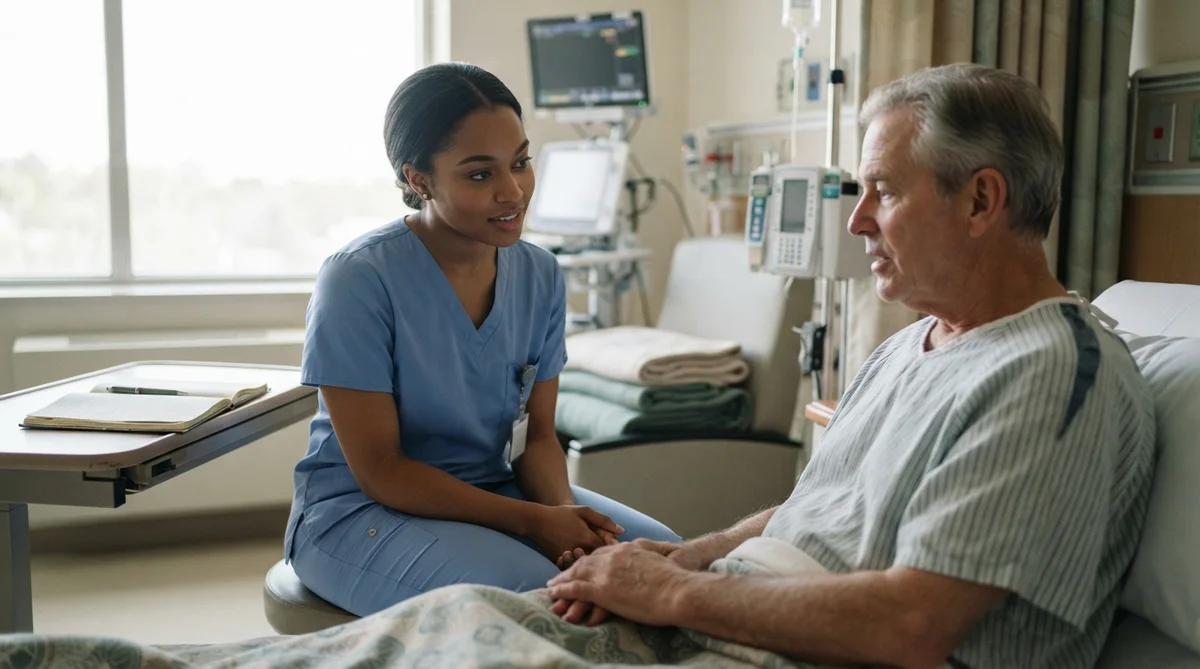
Nursing student patient communication training builds interpersonal de-escalation, active listening, and rapport skills through structured simulation. In a practice station, an educator sets a specific conversational hurdle - such as a patient agitated about a delayed morning procedure - and evaluates whether the student acknowledges distress before explaining ward logistics, redirecting anxiety through grounded, empathetic language.
Key Takeaways
- Effective communication stations separate conversation skills from procedural tasks so students can focus on de-escalation and empathy.
- Fictional role cards work best when they provide emotional triggers rather than scripted lines, testing a student's ability to respond dynamically.
- Feedback rubrics must prioritise observable behaviours - such as unhurried body language and explicit validation - over subjective impressions.
- Coaching should always include an immediate second attempt, reinforcing improved pacing and phrasing before habits solidify.
Designing an Anxious Patient Practice Station
Communication training often fails when scenarios treat patient dialogue as mere background noise around a clinical task. When students try to insert an intravenous cannula or check vital signs while simultaneously calming an agitated patient, they naturally default to technical execution and rush the conversation. To build durable interpersonal skills, educators should isolate the dialogue in a dedicated communication station.
A focused station requires three elements: clear boundaries for the student, an emotionally grounded role card for the patient, and an unambiguous conversational goal. The goal is not to solve systemic hospital delays or offer medical diagnoses; it is to establish psychological safety, clarify the patient's immediate worry, and agree on next steps without escalating tension.
Worked Example: The Anxious Pre-Operative Station
Role: First-year or second-year nursing student entering a day-stay surgical room.
Driving question or Task: Introduce yourself, respond to the patient's visible distress regarding an unconfirmed theatre schedule, and establish a collaborative plan to check the list status without overpromising.
Ambiguity: The patient acts irritable and dismissive about standard nursing questions, concealing a deeper fear of general anaesthesia behind complaints about hospital disorganisation.
What good looks like: The student sits at eye level, pauses before speaking, and validates the patient's frustration directly: "I hear how frustrating it is to sit here fasting without an update, Mr Davies. Let's pause the checklist for a moment. What is worrying you most right now?" Once the underlying dread of anaesthesia is voiced, the student acknowledges the vulnerability, explains the communication workflow calmly, and agrees on an exact time to return with verified information from the surgical coordinator.
Fictional Role Cards
Distribute these role cards to the student and the standardized actor or peer learner prior to the station.
Student Role Card: Pre-Op Interaction
- Setting: Inpatient surgical waiting ward, 10:15 AM.
- Context: You are checking in on Arthur Davies, a 54-year-old admitted at 07:30 AM for a routine knee arthroscopy. He has not eaten since midnight. His procedure was tentatively slated for 09:30 AM, but emergency cases have delayed the morning list.
- Your Objective: Complete an initial conversational check-in, elicit his primary concerns, explain the delay calmly without blaming other teams, and agree on a concrete communication plan.
- Constraints: You do not possess final theatre times. Do not offer clinical assurances about surgical safety or guess procedure start times.
Simulated Patient Role Card: Arthur Davies
- Demographics: 54 years old, admitted for elective knee arthroscopy.
- Internal State: Highly anxious. You have never undergone general anaesthesia and secretly fear not waking up. You are hungry, have a headache, and feel neglected because no one has visited your cubicle for an hour.
- Outward Behaviour: Clenched jaw, arms crossed, sharp tone. You rifle through paperwork or look at your watch repeatedly.
- Escalation / De-escalation Rules:
- If the student gives bureaucratic excuses ("We're short-staffed", "Emergencies come first"), show increased irritation: "I took an unpaid day off work for this. Nobody tells me anything."
- If the student stands over you with a clipboard or tries to brush past your questions, withdraw and respond with short, hostile answers.
- If the student sits down, addresses your frustration calmly, and asks open questions about what is troubling you, drop your defensive posture and admit your fear: "I just hate sitting here thinking about being put under."
Observable Behaviour Feedback Rubric
Educators should avoid generic scores such as "showed empathy" or "appeared confident." Instead, score nursing student patient communication training on concrete actions visible on camera or across the bedside.
| Domain | Developing Behaviour | Proficient Behaviour |
|---|---|---|
| Physical Positioning | Stands near the doorway or hovers over the bed; holds a clipboard or tablet as a physical barrier. | Lowers physical profile to eye level; maintains an unhurried, open posture; places notes aside during distress. |
| Emotional Validation | Minimises the emotional cue with reflexive reassurance (e.g., "Don't worry, you're in great hands"). | Labels and validates the emotional state explicitly before addressing administrative facts (e.g., "It makes complete sense that waiting in silence is stressful"). |
| Inquiry & Pacing | Fires rapid, closed screening questions; interrupts the patient's pauses to fill the silence. | Asks open-ended exploratory questions; allows two to three seconds of silence after emotional disclosures. |
| Setting Boundaries & Commitments | Makes unrealistic promises about list order or deflects blame onto the surgical suite. | States clearly what is known and unknown; provides a realistic time frame for returning with an update. |
Common Student Traps and the Corrective Second Attempt
During debriefs, educators routinely see students stumble into three communication traps:
- Premature Reassurance: Telling an anxious patient "Everything will be fine" before identifying what "everything" means to them. This dismisses the patient's subjective reality.
- Institutional Deflection: Saying "The operating theatre is running behind because of an emergency downstairs." While factually true, this signals that the patient's schedule is unimportant and encourages confrontation.
- Checklist Fixation: Pushing through mandatory documentation while the patient is visibly trembling, tearful, or hostile.
When a student falls into these traps, stop the station immediately. Provide one concrete adjustment - for instance: "Notice how you stood by the door and defended the schedule when he raised his voice. On this replay, pull the visitor chair over, sit down, and start with: 'Mr Davies, I can see how tense this morning has been.'"
Running an immediate 90-second second attempt allows the student to replace an ineffective instinct with a successful physical and verbal habit while the emotional memory of the scene is fresh.
Scaling Practice Scenarios with Scenario IQ
While peer roleplay and actor-based simulation stations are valuable, scheduling and staffing limits often prevent nursing cohorts from getting repeated, individualized conversation practice. Educators seeking to expand conversational rehearsal can integrate AI-powered roleplay through nurse patient communication training models.
Scenario IQ develops bespoke scenarios tailored to an organisation's specific training needs, working alongside universities on educational simulation projects. The platform enables learners to choose their roleplay scenario, select their skill level, and follow customized training pathways. Instead of waiting for infrequent simulation lab days, students can rehearse challenging patient encounters independently.
Following each session, Scenario IQ delivers instant feedback with personalised guidance based on strengths and areas for improvement. This analysis draws on thousands of research-informed data points to evaluate tone, pacing, keyword usage, and communication style. In addition, student dashboards provide reflections on the last interaction and daily actionable tips, while educators and management can track cohort progress over time to identify communication gaps before clinical placement. Healthcare educators can review Scenario IQ's simulation design to complement their existing curriculum.
Limitations and Educational Scope
The practice scenarios and rubrics outlined in this guide are intended strictly for educational communication practice and conversational rehearsal. They do not constitute clinical guidance, diagnostic frameworks, treatment protocols, or legal consent advice. All simulated patient scenarios are fictional and must be reviewed by qualified nursing faculty or clinical simulation leads before deployment in formal curricula. Roleplay simulations support interpersonal technique but do not replace supervised clinical judgment or institutional assessment validity standards.
FAQ
How can trainers teach nursing student patient communication training with a practical scenario?
Trainers should isolate communication challenges from technical clinical tasks, provide realistic role cards with emotional drivers rather than rigid scripts, and enforce rapid, iterative practice cycles. Allowing students to run a short scenario, receive immediate feedback on one observable behaviour, and replay the interaction immediately yields faster skill acquisition than lengthy, unstructured roleplays.
What should a useful nursing student patient communication training exercise include?
A complete training exercise includes a clear setting, specific student objectives with realistic conversational constraints, a patient role card outlining hidden emotional motives and escalation triggers, and an objective rubric focused on non-verbal cues, validation, and inquiry. Pairing these with related resources, such as medical student patient communication training exercises, helps faculty maintain consistent standards across multidisciplinary teams.
What observable behaviours should a reviewer score for nursing student patient communication training?
Reviewers should evaluate objective physical and verbal actions rather than general disposition. Observable indicators include sitting at eye level, actively pausing after patient statements, explicitly acknowledging non-verbal distress, using open-ended questions to explore worries, and giving transparent, boundary-conscious explanations without making speculative procedural promises.
Nursing Communication Station Evaluation Rubric
Copy this worksheet and adapt it to your learners. Any example entries are illustrative. On small screens, scroll across the worksheet.
| Behavioural Dimension | Observable Criterion | Developing (Needs Prompting) | Competent (Consistent) | Proficient (Adaptive) |
|---|---|---|---|---|
| Physical Stance & Proxemics | Position relative to patient eye line and physical barriers. | Stands over patient; clutches clipboard or turns back to patient while talking. | Sits or stoops to eye level; holds relaxed posture with hands visible. | Seamlessly repositions chair to eye level; sets documentation aside when distress appears. |
| Emotional Empathy & Validation | Verbal acknowledgment of the patient's emotional expression. | Ignores emotional distress; offers immediate reassurance like 'You will be fine.' | Acknowledges stated emotion directly before explaining ward logistics. | Validates both verbal emotion and non-verbal tension; normalises feelings without defensiveness. |
| Information Elicitation | Use of open inquiry to discover root causes of anxiety. | Asks leading or rapid-fire closed questions focused only on task completion. | Asks at least one open-ended question to uncover underlying concerns. | Uses open prompts paired with supportive silence to allow patient to voice hidden dread. |
| Expectation Management | Clarity and honesty regarding schedules, delays, and escalation. | Makes definitive promises that cannot be guaranteed or passes blame to other teams. | Clearly separates what is known from what is unknown; provides a realistic time frame. | Transparently outlines next steps, provides a bounded check-in time, and confirms understanding. |