
Last updated: October 2026
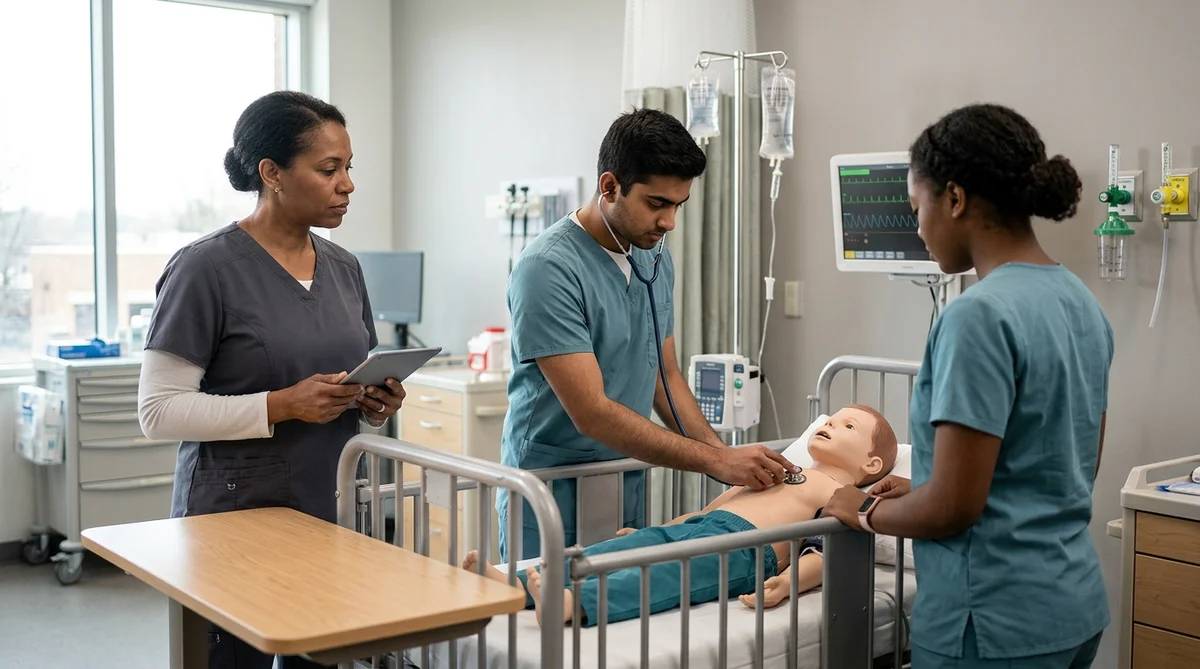
Pediatric nursing simulation scenarios are structured educational experiences that replicate clinical encounters with infants, children, and adolescents to build clinical competency. These scenarios successfully bridge the theory-practice gap by integrating technical procedures with family-centered communication and ethical decision-making. In 2026, high-quality simulations utilize the SoFraSimS 2024 framework to ensure bilingual standardization and scientific validity across diverse healthcare environments, helping students master complex interactions before entering the hospital ward.
Key takeaways
- Validity remains a significant hurdle in the field, as a systematic review found that 56.1% of pediatric simulation studies failed to verify the validity of their scenarios.
- The AACN 2026 Essentials framework serves as the primary standard for integrating competency-based simulation assessments into professional nursing education programs.
- Standardized templates, such as the 41-item pediatric nursing simulation scenario template developed in 2024, provide a scientifically grounded foundation for modern educators.
- Ethics in 2026 focus on the trade-offs between using high-fidelity mannequins for technical skills and adult actors for soft-skill family communication.
What are the core components of pediatric nursing simulation scenarios?
Pediatric nursing simulation scenarios are composed of clinical objectives, environmental setups, and unfolding events that challenge a student's ability to care for younger patients. A 2024 methodological study using the real-time Delphi method established a validated pediatric nursing simulation scenario template consisting of 41 items across nine distinct parts. These items ensure that every simulation has a solid scientific grounding and covers necessary variables like patient history, vital signs, and expected student interventions. Educators use these templates to create consistency, which is vital for fair assessment and repeatable learning outcomes.
The structure of these scenarios often includes a pre-briefing, the active simulation, and a debriefing session. During the active phase, the scenario must evolve based on the student's actions. If a student fails to recognize a drop in oxygen saturation during a pediatric asthma case, the simulated patient's condition should deteriorate realistically. Integrating these structured paths into nursing student simulation scenarios for 2026 clinicals helps learners prepare for the high-pressure environment of a pediatric intensive care unit without risking actual patient safety.
How do INACSL standards influence scenario design in 2026?
The International Nursing Association for Clinical Simulation and Learning, known as INACSL, provides the foundational guidelines for high-quality simulation through its Healthcare Simulation Standards of Best Practice. The fourth edition, released in 2025, emphasizes professional development and evidence-based design. These standards require that pediatric nursing simulation scenarios are developed with clear, measurable objectives and a facilitation plan that supports the learner's psychological safety. Following these guidelines ensures that the training is not just a series of tasks but a holistic educational experience that meets global benchmarks.
In 2026, simulation design also incorporates the SoFraSimS 2024 framework, which was established by 25 simulation experts to standardize healthcare simulation scenario design. This framework provides a bilingual three-template standard that helps educators across different countries share and adapt scenarios. By adhering to these international standards, nursing programs can ensure their graduates are prepared to work in diverse healthcare systems. This standardization also makes it easier for institutions to compare the effectiveness of their training programs and identify areas where students might need more support.
Why is validity verification missing in many pediatric simulations?
Validity verification is the process of proving that a simulation scenario actually measures or teaches what it claims to. A systematic review of pediatric simulation-based education found that 56.1% of analyzed studies failed to verify the validity of their simulation scenarios. This gap is a major concern for the industry because it suggests that many students are being trained or evaluated using tools that haven't been scientifically proven. Without validity, it's hard to know if a student who performs well in a simulation will actually perform well in a real clinical setting.
To fix this, educators in 2026 are increasingly using the 2024 Delphi-validated 41-item template to build their scenarios from the ground up. This template requires developers to document the scientific evidence behind every clinical decision and patient response within the simulation. When institutions use best virtual patient simulation software for 2026 healthcare, they should look for platforms that allow for this level of detailed, evidence-based customization. Ensuring that scenarios are valid not only improves learning but also protects the integrity of nursing certifications and competency assessments.
Which is better: Child simulated patients or adult actors?
Choosing between actual children as simulated patients (SPs) and adult actors or mannequins involves balancing realism with ethics. Using children as SPs can provide an unmatched level of realism for soft-skill training, such as learning how to distract a toddler during a physical exam. However, the ethical challenges are significant, as children may not fully understand the psychological impact of repeating a distressing clinical scenario multiple times. Most programs in 2026 prefer using adult actors to play the roles of parents and high-fidelity mannequins to represent the pediatric patient.
High-fidelity mannequins can simulate physiological changes like cyanosis or lung sounds that a human actor cannot safely replicate. For scenarios focused on family-centered care, adult actors playing the role of a worried parent provide the necessary emotional pressure for the student. This combination allows students to practice communication and technical skills simultaneously. Strategies for maximizing clinical competency in the modern nursing simulation lab usually involve this hybrid approach to ensure student safety and ethical integrity while maintaining high educational value.
How do I adapt pediatric scenarios for global cultural contexts?
Cultural adaptation is the process of modifying a standardized simulation scenario to reflect the specific beliefs, languages, and healthcare practices of a local population. While the SoFraSimS 2024 framework provides a bilingual standard for global use, educators must still adjust the "soft" elements of a scenario. For example, the way a nurse communicates with a family about a child's diagnosis can vary significantly between cultures. A scenario designed for a North American hospital might not be as effective in a rural clinic in Southeast Asia without these adjustments.
Adaptation involves changing the patient's name, the family's communication style, and even the types of medical equipment available in the simulation. It's not just about translation; it's about making the scenario feel authentic to the student's future work environment. This authenticity is what allows the student to fully engage with the simulation and develop true empathy. In 2026, many programs use an AI roleplay training platform to quickly generate variations of a base scenario that reflect different cultural nuances, ensuring that students are prepared for the diverse patient populations they'll encounter in their careers.
How do simulation performance metrics link to real-world patient outcomes?
Linking simulation performance to real-world outcomes is the ultimate goal of healthcare education, yet longitudinal data in this area is still emerging in 2026. Educators are looking for evidence that a student who masters a pediatric asthma scenario in the lab makes fewer errors when treating a child with asthma in the emergency room. Current metrics often focus on immediate skill acquisition, but the AACN 2026 Essentials are pushing for more long-term tracking of competency. By following students from the simulation lab into their first years of practice, researchers hope to prove that simulation directly reduces medical errors.
One way to bridge this data gap is through the use of standardized evaluation tools that track specific behaviors over time. If a student consistently demonstrates high scores in family communication across multiple pediatric nursing simulation scenarios, that data can be compared to their patient satisfaction scores during their clinical rotations. This type of analysis requires a sophisticated data infrastructure within the nursing program. Understanding the future of healthcare education through virtual reality medical simulation can provide insights into how these digital footprints are being used to improve patient safety on a global scale.
Measuring empathy in pediatric nursing simulation scenarios
Empathy and family-centered communication are often called soft skills, but they're technical requirements in pediatric nursing. Measuring these skills is traditionally more subjective than checking if a student administered the correct dose of medication. However, in 2026, new evaluation rubrics are being used to quantify empathy. These rubrics look for specific behaviors, such as the nurse kneeling to be at the child's eye level or using plain language to explain a procedure to a parent. These actions are recorded and scored to provide students with objective feedback on their bedside manner.
Standardized evaluation tools help remove the bias of the individual instructor and provide a clearer picture of the student's progress. Because pediatric care involves the whole family, the simulation must account for the parent's emotional state. If a student ignores a parent's repeated questions while focused on the mannequin, they fail the empathy portion of the scenario. This focus on the human element ensures that future nurses are not just technicians but compassionate caregivers who can handle the emotional complexities of pediatric medicine.
Scenario IQ: The future of AI-driven nursing simulation
Scenario IQ is an AI-driven scenario-based simulation training platform for sales, customer service, support, medical and nursing education, and university student training. By using scenario-based training software, nursing programs can provide students with unlimited opportunities to practice their communication and diagnostic skills in a safe environment. The platform offers AI-powered roleplay simulations that adapt in real-time to student input, providing the kind of adaptive guidance that traditional mannequins cannot. With real-time feedback and performance metric dashboards, Scenario IQ helps educators track student progress toward the AACN 2026 Essentials with precision and ease.
FAQ
What is the SoFraSimS 2024 framework for nursing simulation? The SoFraSimS 2024 framework is a standardized set of guidelines developed by 25 simulation experts to create consistency in healthcare simulation scenario design. It was specifically designed to be bilingual and provides three distinct templates that can be used globally. In 2026, this framework is used to ensure that pediatric nursing simulation scenarios are scientifically valid and can be easily shared between different educational institutions. By using a standardized template, educators can focus on the specific learning objectives of the scenario rather than worrying about the underlying structure, which improves the overall quality of nursing education and student assessment.
How does the AACN 2026 Essentials change pediatric nursing training? The 2026 Edition of "The Essentials: Core Competencies for Professional Nursing Education" by the American Association of Colleges of Nursing (AACN) shifts the focus of nursing education toward competency-based assessment. This means that instead of just counting hours spent in a hospital, students must prove they can perform specific tasks and make sound clinical decisions. Pediatric nursing simulation scenarios are a primary tool for these assessments because they allow students to demonstrate competency in high-risk, low-frequency events that they might not encounter during a typical clinical rotation. The AACN framework ensures that simulation is an integrated, mandatory part of the professional nursing curriculum.
Why is family-centered care a priority in pediatric simulations? Family-centered care is a priority because pediatric patients don't exist in isolation; their health and recovery are deeply tied to their caregivers. In pediatric nursing simulation scenarios, students must interact with both the child and the family members to provide effective care. This requires a high level of empathy and the ability to manage the emotions of parents who may be under extreme stress. By including family dynamics in simulations, educators help students develop the communication skills needed to explain complex medical information to non-professionals. This approach has been shown to improve patient outcomes and family satisfaction in real-world clinical settings.
What did the 2024 Delphi study contribute to scenario design? The 2024 methodological study used the real-time Delphi method to create a validated pediatric nursing simulation scenario template consisting of 41 items across nine parts. This study addressed a major gap in nursing education by providing a scientifically grounded foundation for scenario creation. Before this study, many scenarios were created without a standardized process, leading to the high rates of validity failure seen in earlier research. The 41-item template covers everything from initial patient presentation to specific debriefing questions, ensuring that every aspect of the simulation is designed to meet specific educational goals and clinical standards in 2026.
Can virtual reality replace physical mannequins in pediatric simulation? Virtual reality (VR) is an excellent supplement to physical mannequins but it doesn't completely replace them in 2026. VR is particularly good for practicing diagnostic skills and learning complex workflows in a highly immersive environment. It allows students to experience a wide variety of clinical settings that might not be available in a local simulation lab. However, physical mannequins are still necessary for practicing tactile skills, such as inserting an IV or performing chest compressions on an infant. Most modern nursing programs use a blend of both technologies to provide a comprehensive training experience that covers both cognitive and psychomotor skills.
Scenario IQ provides the tools necessary to bring these advanced pediatric nursing simulation scenarios to life. Whether you're a university looking to modernize your nursing curriculum or a healthcare provider aiming to improve patient safety, our AI roleplay training platform offers the scalability and precision you need. Experience the power of personalized training scenarios and real-time feedback today by exploring how Scenario IQ can transform your clinical education programs.