
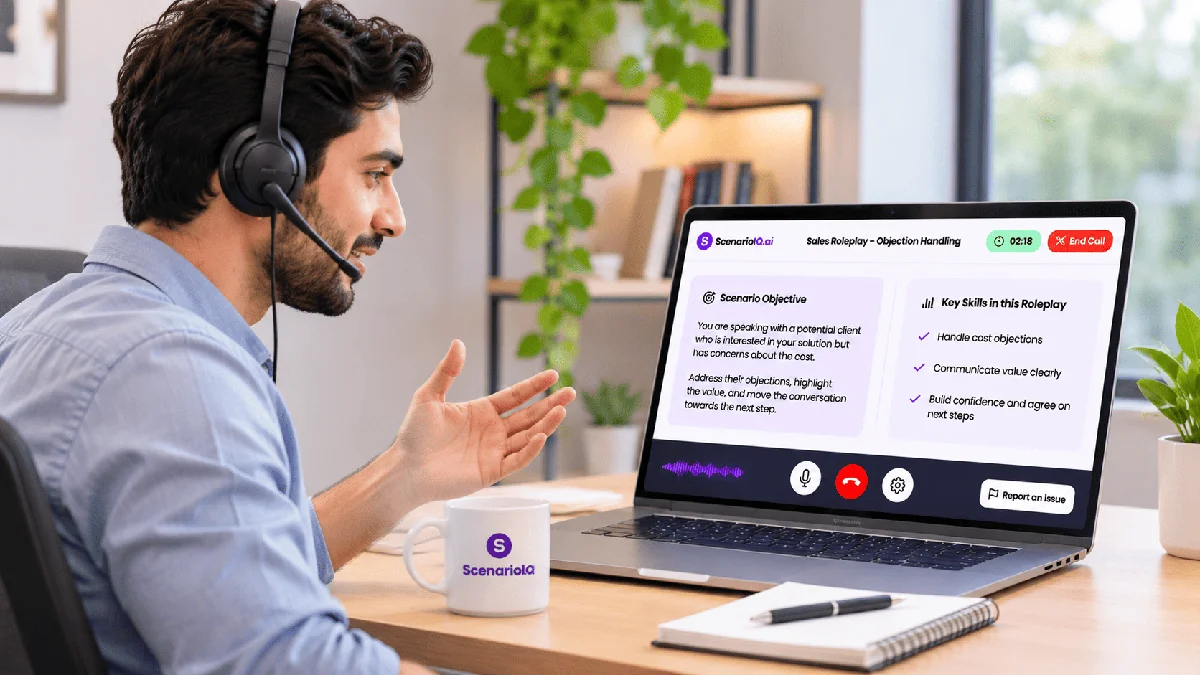
The best AI roleplay training software helps employees practise realistic workplace conversations, receive actionable feedback, and demonstrate measurable improvement before facing customers. For sales and customer service teams, that means rehearsing difficult objections, complaint handling, discovery questions, and next-step agreements in a safe environment. The right platform is not simply the one with the most convincing AI voice; it is the one that makes practice repeatable, feedback understandable, and coaching useful.
Key Takeaways
- Prioritise realistic conversations, configurable scenarios, clear scoring rubrics, and progress tracking over impressive demonstrations.
- Evaluate software using an actual sales or service scenario from your organisation rather than a generic vendor script.
- Measure observable behaviours, including listening, clarification, objection handling, empathy, and agreement on next steps.
- Run a small pilot with baseline scores and manager reviews before committing to an organisation-wide rollout.
What Makes AI Roleplay Training Software Effective?
Traditional workshops often explain what a good conversation sounds like but provide limited opportunities to practise it. Managers must organise partners, observe interactions, and repeat exercises for each learner. AI roleplay software can make that practice more accessible by simulating customer responses and providing structured feedback after each attempt.
However, a realistic conversation alone does not prove learning. A useful platform must connect scenario objectives to observable actions and show whether performance improves over repeated attempts. This guide focuses on practical evaluation, workplace scenarios, and measurable coaching rather than unsupported claims that one vendor is universally best.
The Practical Test: A Fictional Sales Roleplay
Consider a business development representative speaking with a prospect who likes the product but believes the proposed price is too high. The exercise should test the representative's ability to explore concerns rather than immediately offering a discount.
Fictional Scenario Setup
Role: Sales Representative speaking with a cautious purchasing manager (Fictional Character: Jordan Ellis).
Driving question or Task: Understand Jordan's pricing concern, identify the purchasing criteria, explain relevant value without inventing savings, and agree on a reasonable next step.
Ambiguity: Jordan has received a cheaper competitor quotation but has not shared whether implementation support, service levels, or long-term costs are comparable. Jordan is busy and dislikes scripted sales pitches.
What good looks like: The representative acknowledges the concern, asks an open question such as "Which parts of the proposals are you comparing most closely?", summarises the answer, explains only verified differences, and suggests a short side-by-side review rather than pressuring Jordan to buy immediately.
Roleplay Prompts and Participant Cards
Use these parameters in an AI simulation platform or a manager-led practice session:
- AI Customer Persona (Jordan Ellis): Purchasing manager at a growing company. Analytical, budget-conscious, and skeptical of vague ROI claims. If the representative repeats generic value statements, Jordan responds: "That sounds like every other vendor. Why should I pay more?" If the representative asks thoughtful questions and distinguishes verified capabilities, Jordan becomes willing to discuss the evaluation criteria.
- Representative Objective:
- Acknowledge the price objection without becoming defensive.
- Ask what matters most in the buying decision.
- Explain relevant value using approved, verifiable information.
- Agree on a specific, low-pressure follow-up action.
Observable Behaviour Rubric
To compare AI roleplay training software fairly, score the same scenario using consistent behavioural criteria. Human reviewers should check whether automated feedback accurately reflects the conversation, rather than accepting a numerical score without explanation.
| Competency | Target Behaviour (Score 3) | Developing Behaviour (Score 2) | Unacceptable Behaviour (Score 1) |
|---|---|---|---|
| Discovery and Listening | Asks an open question, listens, and summarises the customer's actual priorities. | Asks a relevant question but moves on without confirming the answer. | Assumes the customer's priorities and delivers a memorised pitch. |
| Objection Handling | Acknowledges the concern and explores the basis of the comparison. | Acknowledges the objection but responds with generic reassurance. | Dismisses the concern or immediately offers an unapproved discount. |
| Value Communication | Connects verified product capabilities to the customer's stated requirements. | Explains product features with limited connection to customer needs. | Makes unsupported savings claims or misrepresents competitor capabilities. |
| Next-Step Agreement | Confirms a clear follow-up action, owner, and timeframe. | Suggests follow-up but leaves the details unclear. | Pressures the customer or ends without an agreed next step. |
Essential Features to Compare Before Buying
- Conversation Realism: Test whether the AI responds naturally to interruptions, questions, hesitation, and changing customer priorities. A scripted exchange is not enough.
- Scenario Customisation: Look for customer personas, industry context, product constraints, difficulty settings, and approved messaging that match your organisation.
- Actionable Feedback: Require specific examples of what the learner said, why a response was effective or ineffective, and what to try next.
- Manager Analytics: Check whether supervisors can identify skill gaps, compare repeated attempts, and plan targeted coaching.
- Security and Administration: Review role-based access, data retention, recording permissions, procurement requirements, and integration options before rollout.
Common Mistakes When Selecting AI Roleplay Software
- Choosing Based on Voice Quality Alone: A natural-sounding AI customer is helpful, but the system must also teach and assess meaningful workplace behaviours.
- Trusting a Single Overall Score: A score of 85 means little without evidence. Ask to see the transcript excerpts and rubric criteria behind it.
- Using Generic Scenarios: Practice about an unrelated product may not prepare staff for real objections, policies, and customer expectations.
- Confusing Participation with Performance: Completed roleplays show activity, not necessarily improvement. Compare baseline and later performance using the same criteria.
Next Practice Attempt: Increasing Difficulty
After a learner completes the baseline pricing conversation, introduce controlled variations that test whether the skill transfers to less predictable situations:
- Variation A (Impatient Buyer): Jordan has only two minutes and asks for the lowest price immediately. The representative must clarify the main decision factor and agree on a concise follow-up without rushing into a discount.
- Variation B (Multiple Stakeholders): Jordan explains that finance and operations disagree about the preferred vendor. The representative must identify both stakeholders' criteria and propose a useful comparison document without promising an outcome.
Implementing AI Roleplay Training with Scenario IQ
Scenario IQ is a relevant option to evaluate for structured sales and customer service practice. The platform focuses on personalised, scenario-based conversations, repeatable training, feedback, and performance visibility rather than relying on one-off classroom exercises.
Scenario IQ supports tailored roleplay scenarios based on organisational requirements, customer personas, and training objectives. Sales teams can practise discovery, objection handling, and difficult negotiations, while service teams can rehearse complaint resolution, empathy, and clear policy explanations. Training administrators can align exercises with their preferred competencies and skill levels.
After a roleplay, learners can review feedback and performance scores to identify strengths and improvement areas. Repeated attempts help turn a broad coaching recommendation, such as "ask better questions," into a specific behaviour that can be practised and evaluated. Managers can use reporting and progress insights to identify patterns and support follow-up coaching.
The best way to assess Scenario IQ is to test one realistic scenario from your own organisation, review the resulting feedback against a human manager's assessment, and check whether the reporting answers your team's training questions. Explore Scenario IQ to discuss a pilot and confirm current platform capabilities, deployment requirements, and pricing.
FAQ
What is the best AI roleplay training software for sales teams?
The best choice depends on your sales process, coaching requirements, budget, and technical needs. Prioritise realistic buyer conversations, customisable objections, explainable feedback, and analytics that track progress. Test shortlisted platforms with the same scenario before choosing.
How should organisations evaluate AI roleplay training software?
Use a real workplace scenario, define observable scoring criteria, and have learners complete multiple attempts. Compare the platform's feedback with manager assessments, examine usability and reporting, and review security, administration, and commercial terms.
Can AI roleplay software replace human sales coaches?
AI can make routine practice and feedback more accessible, but it should complement rather than replace managers. Human coaches remain important for validating advice, interpreting customer context, reinforcing standards, and connecting practice results to actual workplace performance.
AI Roleplay Software Evaluation Worksheet
Copy this worksheet when evaluating vendors. Example entries are illustrative. On small screens, scroll across the worksheet.
| Evaluation Stage | Buyer Objective | Practical Test | Evidence to Request | Red Flag |
|---|---|---|---|---|
| 1. Scenario Realism | Verify that the simulation resembles real work. | Run a pricing objection with an impatient customer persona. | Full conversation and customer responses. | AI repeats scripted answers regardless of learner input. |
| 2. Feedback Quality | Confirm that coaching is specific and defensible. | Compare a weak attempt with an improved attempt. | Rubric scores and examples tied to the conversation. | Generic praise or unexplained scores. |
| 3. Progress Measurement | Understand whether skills improve over time. | Review multiple attempts by a small learner cohort. | Individual and team progress reports. | Only completion counts are available. |
| 4. Deployment Readiness | Validate fit with organisational controls. | Review roles, data handling, and onboarding. | Security documentation and administrator walkthrough. | Unclear access or retention policies. |
| Your Vendor Test | [Your priority] | [Your scenario] | [Required evidence] | [Deal-breaker] |